Hydrochem

hydrochem is a free, open-source and user-friendly software dedicated to the processing, analysis and visualization of hydrochemical data.

hydrochem was developed in the framework of the French SNO Karst and the Chaire GeEAUde. It can be launch with the R software.

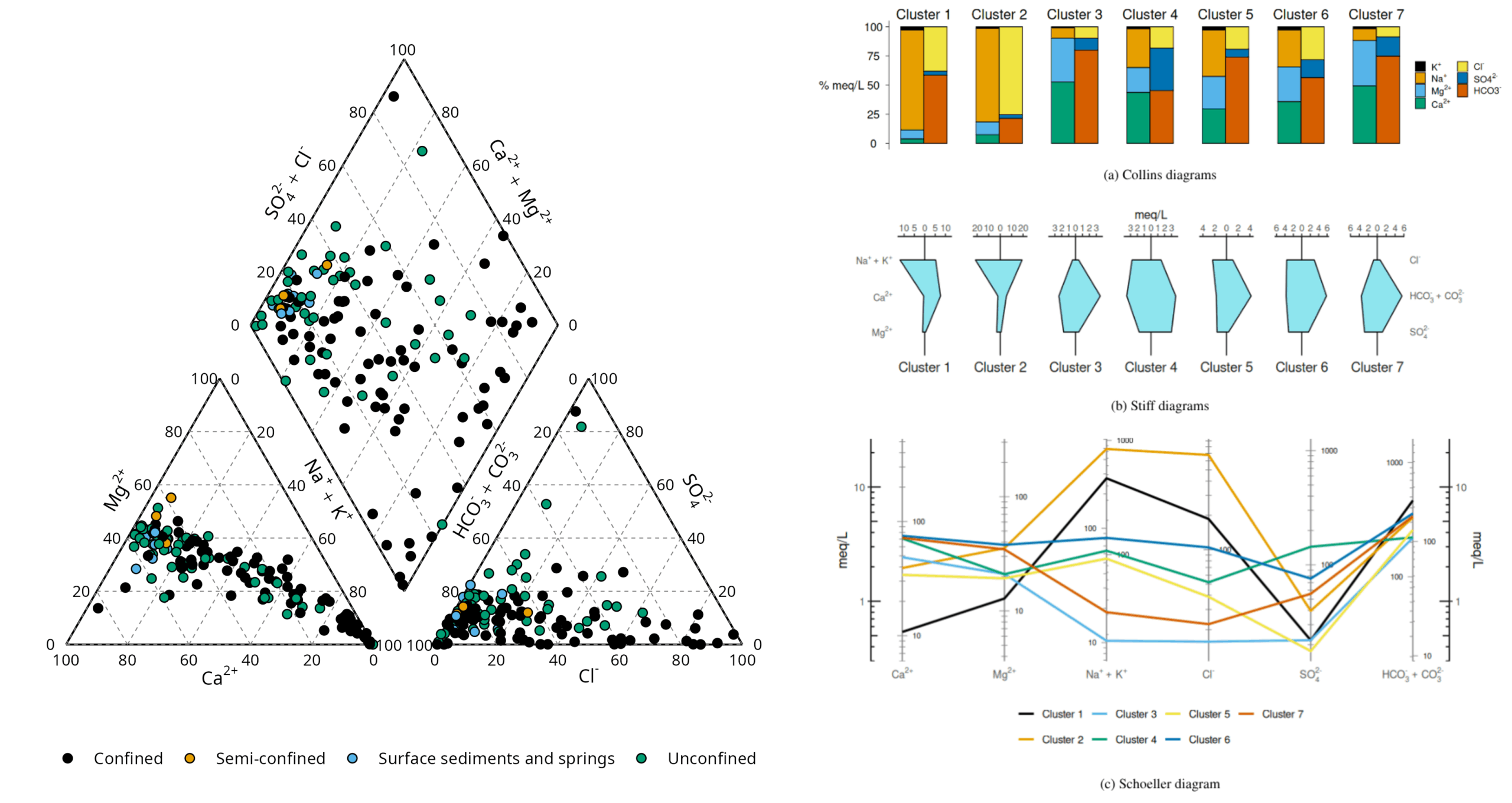
hydrochem provides a comprehensive suite of tools for processing, analyzing, and visualizing hydrochemical data in a reproducible and programmatic workflow. Implements unit conversion, censored data management, ionic balance calculation, water type classification, and a range of hydrochemical indices relevant to water quality assessment. Offers advanced visualization functions for generating Piper (Piper, 1944), Durov (Durov, 1948), Stiff (Stiff, 1951), Collins (Collins, 1923), Schoeller (Schoeller, 1935), Gibbs (Gibbs, 1970) and ternary diagrams — the standard graphical tools used in hydrochemical interpretation.

Unlike existing solutions that rely on spreadsheets or proprietary graphical software, hydrochem’ is designed for scalability and reproducibility, lowering the technical barrier for hydrochemists working with datasets of varying complexity. It integrates seamlessly into modern R workflows and supports rigorous water resource management and research

hydrochem is available from R (version 4.0.0 or later)

Please quote us as follows

Cinkus, G., Mazzilli, N., Jourde, H.. KarstID: An R Shiny application for the analysis of karst spring discharge time series and the classification of karst systems hydrological functioning. Under review for Environmental Modelling & Software.

To install the software

install.packages("hydrochem")

Once the package is installed, the functions can be accessed with:

library(hydrochem)

More details can be found in the user guide (https://github.com/snokarst-tools/hydrochem).

REFERENCES

  • Collins, W. D. (1923): Graphic Representation of Water Analyses, Industrial & Engineering Chemistry, 15(4), 394–394.
  • Durov, S. A. (1948): Natural waters and graphic representation of their composition, Doklady Akademii Nauk SSSR, 59(3), 87–90.
  • Gibbs, R.J. (1970): Mechanisms controlling world water chemistry, Science, 170(3962), 1088–1090,
    https://doi.org/10.1126/science.170.3962.1088
  • Piper, A.M. (1944): A graphic procedure in the geochemical interpretation of water-analyses, Eos, Transactions American Geophysical
    Union, 25(6), 914–928, https://doi.org/10.1029/TR025i006p00914.
  • Schoeller, H. (1935): Utilité de la notion des échanges de bases pour le comparaisons des eaux souterraines, Société Géologie Comptes
    Rendus Sommaire et Bulletin, série, 5, 651–657.
  • Stiff, H.A. (1951): The interpretation of chemical water analysis by means of patterns, Journal of Petroleum Technology, 3(10), 15–17, https://doi.org/10.2118/951376-G.
  • R Core Team (2025): R: A Language and Environment for Statistical Computing, R Foundation for Statistical Computing, Vienna, Austria.
hydrochem plots